CARITAS LIRA PROFILE: Please click on the links below to readmore info.
1 - BACKGROUND OF CARITAS LIRA:
Caritas Lira is a faith-based organisation that operates within Lira Diocese covering Lango sub region. Caritas targets the vulnerable communities to improve on their livelihoods. Caritas in Lira Diocese was officially opened in March 2000. Caritas Lira operates under the certificate of incorporation of Lira diocese.
Caritas Lira, the implementing partner for the present action, is the diocesan organization mandated for Lango sub-region. It was established in 2000 to promote human development and improve the livelihoods of vulnerable people and communities by fostering community-based initiatives.
Caritas Lira provides assistance and support to vulnerable groups regardless of their background, nationality, gender, political, philosophical or religious beliefs. It is active in 5 programmatic areas: agriculture (food security and economic development); water, sanitation and hygiene (WASH); social protection and legal strengthening; renewable energy (biogas and solar energy); and capacity building. Actions in recent years include projects concerning food security, sustainable ecological agriculture, income generating activities, promotion of savings and credit, WASH, etc. For these projects, donor partners of Caritas Lira were among others Broederlijk Delen (DGD program), USAID, CRS and UNICEF.
Caritas Lira regularly collaborates with ZARDI, Uganda Technical College, and Makerere and Uganda Martyrs Universities and participates in the Lango Food Security and Nutrition Cluster and several networks and platforms (Climate Action Network Uganda, Uganda Water and Sanitation Network and Uganda Farmers’ Common Voice platform). It is also member of PELUM (Participatory Ecological Land Use Management) Uganda.
Caritas Lira is aware that the increasingly complex challenges that its target population is faced with, require various development actors to join forces. In working towards achieving its objectives, it therefore seeks close collaboration with other actors, whether government line offices, civil society organizations, other NGOs or donor organizations. Finally, Caritas Lira adheres to a participatory approach, entailing a process of inquiry and dialogue with communities and target groups throughout the project cycle. Participatory facilitation is a crucial element of Caritas Lira’s commitment to ensure sustainability of the results of its actions.
VISION: To improve the standard of living of families under Lira diocese through love, solidarity and reconciliation:
GOAL: Having life in its fullness
MISSION: To foster community-based initiatives that promote charity, solidarity and social justice becoming an instrument of reconciliation and human development in Lango sub-region.
2- Thematic areas of focus:
CARITAS LIRA will focus but not limited to the six thematic areas. These programme areas include:
- Agriculture (Food Security and Economic Empowerment)
- Capacity building initiatives
- Social Protection and legal strengthening
- Water sanitation and hygiene improvement
- Renewable Energy (Biogas and Solar Energy)
3- Strategies
- Partnerships – Sometimes the problems facing communities seem to defy solutions. But the only certainty is that these increasingly complex challenges exceed the capabilities of any single sector or any organization to solve them alone. Implementing CARITAS LIRA strategic objectives requires close collaboration with a wide range of strategic partners within government, civil society and donor community. The method of operation for CARITAS LIRA will be through close collaboration and partnering with the community groups and other actors. CARITAS LIRA through it links with International and national network is well positioned to link with local communities, government, Faith Based organisations and non-governmental partners, NGO coalitions. These relationships will allow CARITAS LIRA to work with, on behalf of or through these partners.
- Advocacy – CARITAS LIRA will ensure that support for local advocacy initiatives of the vulnerable, marginalised groups is undertaken. In addition, together with its partner network, CARITAS LIRA will bring a multi-level capacity to address issues at national and diocesan levels and bring local experience into the debates on key issues about support to the vulnerable.
- Capacity development – involves the ability of an organisation to perform functions effectively, efficiently and in a sustainable manner. It incorporates the abilities, skills, understanding, attitudes, values, relationships, behaviours, motivations, resources and conditions that enable such functioning to occur over time and in changing circumstances. Sustainability is primarily the work and responsibility of local communities, parish units and project committee as the local Caritas structures. CARITAS LIRA will bring to this task a commitment to the empowerment of its target group through participatory facilitation, capacity building and access to resources, experience and commitment to community development by supporting the most vulnerable and disadvantaged.
- Participation – Participation will entail a process of inquiry and dialogue through which community and target group share ideas in ways that help them to have a multi-dimensional perception of their needs. The causes and effects of these needs will be analyzed by key stakeholders so that decisions for effective future common action can be made. Furthermore, all stakeholders will identify preliminary indicators for assessing progress, implement activities and then assess progress through monitoring and evaluation based on their objectives. Participation will be seen as a four phase cycle- problem identification, followed by reflection and deeper analysis, enabling a decision to be made, which has to be followed by an action plan
- Networking – CARITAS LIRA works within Lango sub region. It shares values and wealth of diverse and specialized resources. This national and global partnership and resource base offers a multitude of possibilities for cooperation, and diversity of response. CARITAS LIRA seeks to make the optimal use of this network through contributing its own expertise and workingcooperatively with others to seek the maximum stewardship of this shared resource of skill, experience and knowledge in supporting its target group in Lango sub region.
- Gender Mainstreaming – CARITAS LIRA will in its work uphold planning that takes into consideration the impact of policies and plans on women and men; girls and boys; and is sensitive to peculiar/specific gender needs. Since men and women (children, boys and girls) have different gender roles, do different types of work, have different degree of access to and control over services and resources, and experience unequal relations. The gender needs are the needs women and men identify in their socially accepted roles and position in society. CARITAS LIRA will ensure that the gender responsive in the targeting the interventions for the most vulnerable and the disadvantaged is considered.
4- Areas of Operations
Caritas Lira is the socio-pastoral arm of the diocese of Lira and it is one of the commissions in the diocese. It coordinates development activities within the districts of Lango sub-region that include Alebtong, Apac, Amolatar, Dokolo, Kole, Oyam, Otuke, and Lira
5- Organization structure
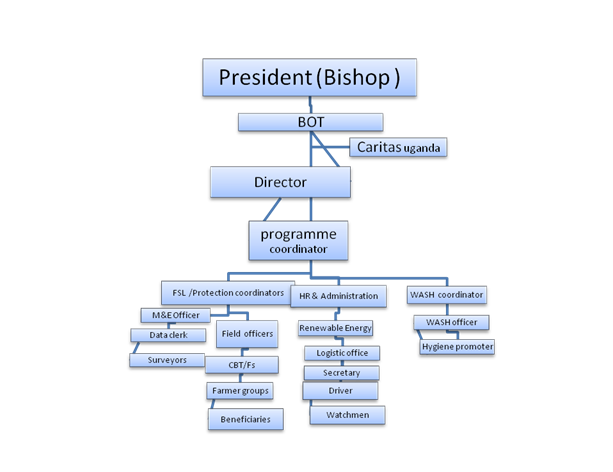
6- Strength of the Organization
- Strong and committed executive committee (BOG), Management, and committed staff for effective service delivery.
- Collaboration with line actors within the sub region supports in proper planning for our intervention and improved service delivery for the communities.
- Good working relationship with local government
- Competent and qualified staff in place
- Having a clear vision helps us to strive to achieve our mission.
- Open accountability and transparency within the office and beyond.
- Involving all stakeholders in planning process for intervention,
- The church structure right from the diocese, parishes and chapels helps so much in promoting our activities and sustainability of intervention.
7- Project Monitoring and Evaluation system
Plan tracking will focus on monitoring results. Annual plans and work schedules are laid out from the strategic plan. The following monitoring mechanisms always guide the implementation of the proposed actions of Caritas: –
- Quarterly meetings of Caritas management staff with the Board (Executive Committee) to review progress of the implementation plan activities
- Annual review progress with Board and partners
- Field support visits on quarterly basis by Coordinator Monitoring and Evaluation officer, as well as on spot assessment if and when required
- Monthly and quarterly reports from staff
- Reporting on intended results by CARITAS LIRA management
- Mid and end term evaluation (design, effectiveness, relevance of the plan)
- CARITAS LIRA monitoring of progress against the set objectives in the implementation plan
Caritas Lira previous Experience
Caritas is a church based organization focusing on socio- economic development of the people in Lira diocese, comprising of Lira, Oyam, Otuke, Amolatar, Alebtong, Apac, Kole and Dokolo districts. It operates with the permission of the diocese of Lira with the certificate of incorporation dated 1970.
Caritas Lira works with people of all categories to promote integral development without segregating anybody in any way. Caritas Lira up to recent times had been involved in a number of interventions which include: Water and sanitation in Lango sub region (spring protection and shallow wells); Income Generating Activity (IGA) projects to the vulnerable community in Lango sub- region; Development work like: Sustainable Comprehensive Responses for Vulnerable children and their families (SCORE) founded by USAID; Agro Enterprise and SilC[1] in rural economies (ASPIRE) funded by CRS; Child Protection Programme funded by UNICEF; Food security project supported by the office of the vice president of Uganda; Recovery and Resettlement project supported by Caritas Australia; Sustainable Agriculture supported by Broederlijk Delen. Community health project funded by UNICEF; Reception and rehabilitation centre for the formerly abducted children who have escaped from captivity; Construction of one girls’ secondary school in Lira district;
The Catholic Church like other faith based organizations is traditionally involved in the caring and supporting of less privileged and disadvantaged members of the society.
In addition to the above, CARITAS LIRA has set up an M&E framework which was adopted and tailored to suit its operations in the new operations for effective service delivery. Concise and precise reporting formats will have to be developed to monitor progress and ensure accountability at all levels. Specifically, CARITAS LIRA has in place an M&E matrix for the strategic monitoring.
[1]Saving and Internal Lending among rural communities